
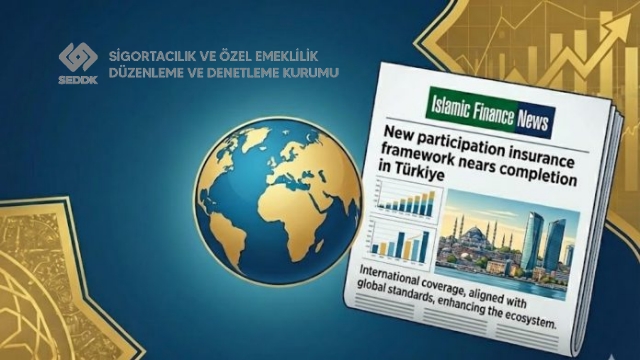
SEDDK’nın taslak katılım sigortacılığı yönetmeliği uluslararası basında
Islamic Finance News (IFN), hazırladığı haberde SEDDK tarafından hazırlanan taslak katılım sigortacılığı ve bireysel emeklilik düzenlemesine yer verdi.
Katılım finans alanında uluslararası ölçekte yayın yapan Islamic Finance News (IFN), “New participation insurance framework nears completion in Türkiye” başlıklı haberinde, Sigortacılık ve Özel Emeklilik Düzenleme ve Denetleme Kurumu (SEDDK) tarafından hazırlanan taslak katılım sigortacılığı ve bireysel emeklilik düzenlemesine yer verdi.
Haberde, taslak düzenlemenin katılım sigortacılığının kapsamını genişletmeyi, ürün çeşitliliğini artırmayı ve sektörün uluslararası standartlarla uyumunu güçlendirmeyi hedeflediği vurgulandı.
Ayrıca düzenlemenin, katılım finans ekosisteminde yönetişim mekanizmasını geliştirmeye yönelik önemli adımlar içerdiği belirtildi.
IFN’in haberinde, katılım sigortacılığına ilişkin çalışmaların Türkiye’nin üst politika belgeleriyle uyumu, uygulamada öngörülen model ve yöntemler ile düzenlemenin hayata geçiş sürecine yönelik bazı teknik başlıklar da özetle aktarıldı.
Habere aşağıdaki bağlantıdan ulaşabilirsiniz:
New participation insurance framework nears completion in Turkiye
Turkiye is set to issue a new regulation on participation insurance and private pensions “in the very near future”, the Insurance and Private Pension Regulation and Supervision Agency (IPRSA) told IFN. The draft regulation, now in its final stage, will expand the scope of participation insurance, increase product diversity, enhance compliance with international standards and improve sector governance. RADHIKA DAS has the details.
Participation insurance remains one of the key pillars of Turkiye’s participation f inance system, Sanbaz Yildirim, the head of the participation insurance department at the IPRSA said. As of October 2025, eight insurance companies operate in line with Shariah principles: four in non-life insurance, three in life insurance and private pensions and one in reinsurance. The segment generated TRY53 billion (US$1.24 billion) in premiums during the same period, which is a 59% increase from the previous year, representing around 5.5% of total insurance premiums.
The first regulation on participation insurance was introduced in 2017, followed by a second in 2020. “The new regulation is not intended to abolish the existing framework, but rather to broaden its scope, strengthen alignment with international standards and provide the most comprehensive framework to date for participation insurance,” Sanbaz noted, adding that attention was particularly given to compliance with AAOIFI’s Islamic Insurance Standard No 26 and Islamic Reinsurance Standard No 41.
The draft regulation highlights provisions for the operation of participation insurance funds including rules on income and expenditure, periodic reporting and the segregation of policyholder and shareholder funds. standards of three international standardsetting bodies in the participation finance f ield were examined to enhance the framework. During the drafting phase, the IPRSA “The draft regulation contains explicit provisions requiring a clear segregation between the participation insurance funds belonging to policyholders and the shareholder funds belonging to the company, as well as separate, consistent and traceable reporting of these funds,” explained Sanbaz.
It also regulates operating models such as Wakalah and hybrid WakalahMudarabah structures, the use of Qard Hasan arrangements, surplus distribution and the duties of the Shariah advisory committee, additionally providing coverage on compliance mechanisms, customer disclosure requirements as well as training and certification processes.
Drafting phase
“In preparing the draft, we conducted an in-depth analysis of successful participation insurance practices around the world, the relevant legislation of leading jurisdictions in this field and the Fiqh, accounting and governance standards issued by internationally recognized institutions and organizations,” Sanbaz added.
Separate reports were prepared for each country reviewed, followed by a comprehensive master report compiling comparative findings. In total, the legislation of 15 countries and the standards of three international standardsetting bodies in the participation finance f ield were examined to enhance the framework.
During the drafting phase, the IPRSA held a comprehensive consultation process, engaging public institutions, insurers, audit firms, industry associations, NGOs and academia. The draft was shared and discussed in a dedicated workshop involving academics and industry representatives. Feedback and proposals received were reviewed and incorporated into the final text.
A six-month transition period will be granted once the regulation is effective, allowing companies enough time “to fully align their operations with the new framework”. It is anticipated that public confidence and awareness will be enhanced, potentially increasing the country’s participation insurance market share to around 15% in the coming years.
The upcoming regulation is part of the government’s broader strategy to further participation finance, as outlined in multiple high-level policies: the ‘Twelfth Development Plan (2024-28)’, the ‘Medium-Term Program (2025-27)’ and the ‘Participation Finance Strategy Document’ issued by the presidential f inance office.


